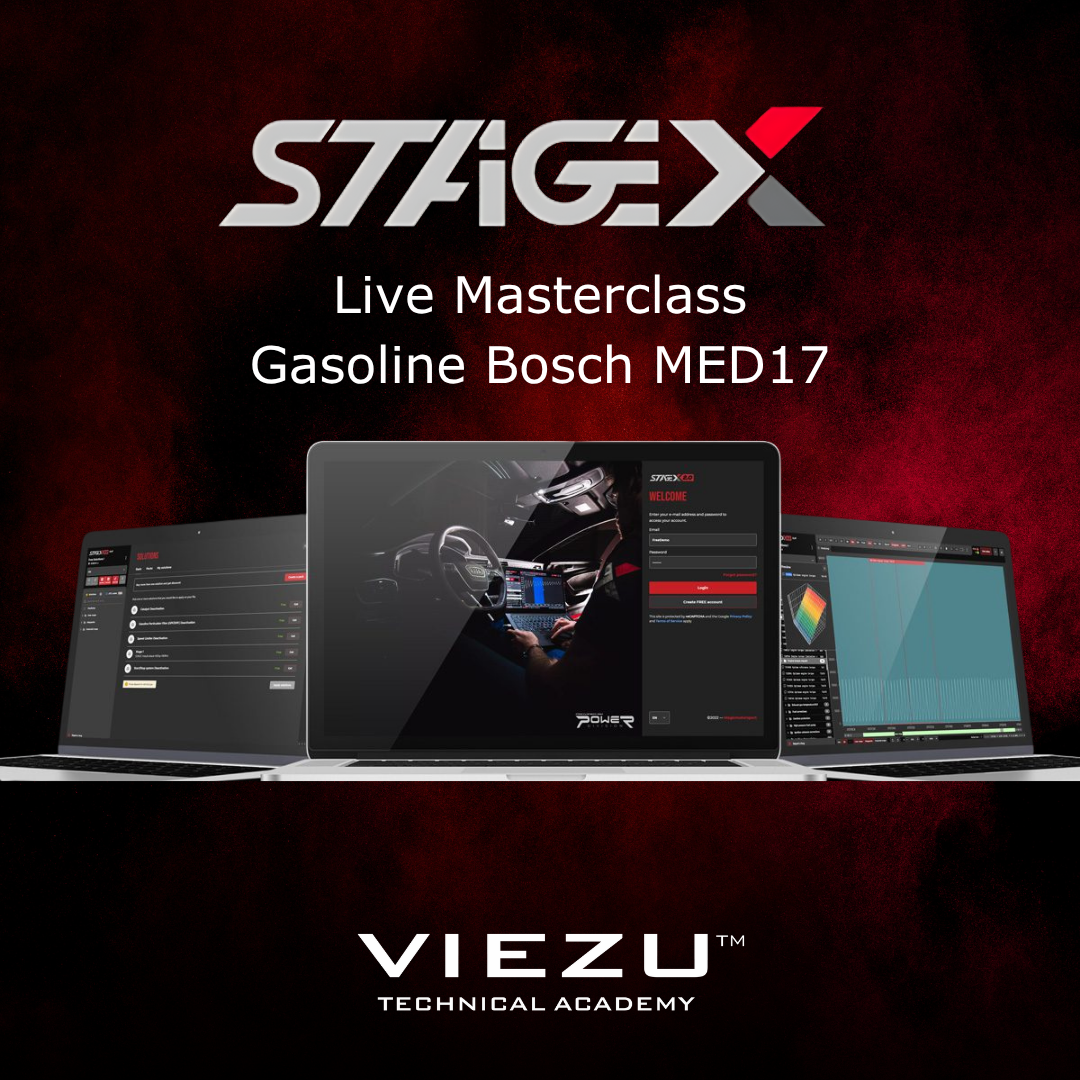
Introduction to the StageX Gasoline Tuning Workflow
Volkswagen Golf GTI 2.0 TSI – Bosch MED17.5
Date: Thursday 20th August 2026
Time: 5pm (BST)
Duration: 2 Hours
Delivery: Live Online Masterclass Webinar
Price: £199 per student
Software: StageX
Vehicle: Volkswagen Golf GTI 2.0 TSI
ECU: Bosch MED17.5
This live two-hour masterclass introduces a professional and structured approach to gasoline ECU calibration using StageX.
Working with an original Volkswagen Golf GTI 2.0 TSI Bosch MED17.5 ECU file, the session will explain how the ECU manages driver demand, engine torque, cylinder filling, boost pressure, ignition timing, fuelling and component protection.
Rather than treating individual maps as isolated areas to increase, the webinar will focus on understanding how the relevant calibration strategies work together and how they should be approached when developing a professional Stage 1 performance tune.
The session will begin with an analysis of the original ECU file before progressing through the complete Stage 1 calibration process inside StageX.
This section will cover:
- Introduction to the Bosch MED17.5 ECU
- StageX as the working calibration environment
- The principles of torque-based gasoline engine management
- The importance of analysing the original file before making changes
- The difference between isolated map editing and strategy-based calibration
- Defining an appropriate Stage 1 tuning objective
- Maintaining structured and responsible calibration practices
The objective is to establish a repeatable workflow: understand the ECU strategy, define the tuning target and then modify the calibration with purpose.
Stock File Analysis and MED17 Strategy Walkthrough in StageX
Participants will explore the original Bosch MED17.5 file directly inside StageX.
As each relevant map table is reviewed, the webinar will explain its function, how it fits into the overall MED17 control strategy and why it may be relevant to a Stage 1 calibration. The focus will be on learning how to interpret the original calibration and understand the relationship between the principal torque, load, boost, ignition and fuelling strategies before any modifications are made.
This section will cover:
- Loading and reviewing the original ECU file
- Reviewing ECU and software identification
- Navigating StageX map groups and categories
- Reading map names, axes, units and calibration values
- Using StageX table, 2D and 3D viewing modes
- Understanding map shape and calibration intent
- Identifying requests, limiters, conversions and protection strategies
- Recognising which maps are relevant to the tuning objective
- Distinguishing important calibration maps from unrelated available data
- Understanding how the stock calibration areas interact
Key MED17 strategy and map areas reviewed will include:
Driver Demand and Requested Torque
Participants will review how accelerator-pedal input is converted into a requested engine output within the MED17 torque structure.
Covered areas include:
- Accelerator-pedal request maps
- Pedal position and engine-speed axes
- Requested torque structure
- Part-throttle and full-load demand
- Pedal progression and response
- Low-engine-speed torque request
- High-load demand
- Driveability considerations
- Why driver demand should not be treated as a simple power-increase map
Torque Limiters and Torque Structure
The webinar will examine the main torque-limiting structure and explain how torque is used as a central reference for engine control.
Covered areas include:
- Principal engine torque limiters
- Engine-speed-dependent torque limits
- Maximum permitted torque
- Drivetrain and transmission-related considerations
- Temperature and protection-related torque reductions
- Torque intervention awareness
- Torque monitoring considerations
- Maintaining consistency between requested and permitted torque
- Understanding why raising one torque limiter may not produce the intended result
Torque-to-Load and Cylinder-Filling Strategy
Participants will be introduced to the relationship between requested torque, calculated engine load and cylinder filling.
Covered areas include:
- Torque-to-load relationships
- Requested cylinder filling
- Load request and load limitation
- Air-charge calculation
- Engine-speed and load operating areas
- How the ECU converts torque demand into an airflow requirement
- The relationship between load, boost pressure and engine output
- Why torque and load changes must remain logically aligned
- Recognising calculated and modelled calibration areas
Boost-Pressure and Charge-Control Strategy
Participants will review how the MED17 ECU calculates and controls the charge pressure required to support the requested engine load.
Covered areas include:
- Boost-pressure targets
- Charge-pressure request
- Boost-pressure limitation
- Load-dependent boost strategy
- Turbocharger control awareness
- Pressure-ratio considerations
- Atmospheric and environmental correction awareness
- Boost intervention and protection
- Relationship between torque, cylinder filling, airflow and boost
- Why additional boost must support a defined load and torque objective
Ignition-Timing Strategy
The session will explain the role of ignition timing in gasoline engine performance, combustion efficiency and component protection.
Covered areas include:
- Base ignition timing
- Full-load ignition maps
- Part-load and high-load ignition areas
- Engine speed and load relationships
- Ignition advance and retard
- Combustion phasing awareness
- Knock-control strategy
- Knock correction and safety margins
- Temperature-related ignition corrections
- Fuel-quality considerations
- Why ignition timing must not be calibrated as an isolated performance map
The webinar will focus on how ignition timing supports the wider calibration objective without unnecessarily reducing combustion safety margins.
Lambda and Fuel Strategy
Participants will examine how the ECU controls the air-fuel mixture across different engine operating conditions.
Covered areas include:
- Lambda targets
- Full-load enrichment
- Part-load and high-load lambda strategy
- Lambda in relation to load and engine speed
- Fuel mixture and combustion temperature
- Component-protection enrichment
- Exhaust-temperature considerations
- Fuel-quality considerations
- Interaction between lambda, boost and ignition timing
- Why richer does not automatically mean safer or more powerful
- Maintaining consistency across related fuelling maps
Fuel-Pressure Strategy
The webinar will review the role of the direct-injection fuel-pressure system within the MED17 calibration.
Covered areas include:
- High-pressure fuel request
- Fuel-pressure limits
- Engine-speed and load relationships
- Fuel delivery at increased engine load
- Fuel-system capacity considerations
- When fuel-pressure changes may or may not be required
- Avoiding unnecessary fuel-system stress
- The relationship between fuel pressure, injection delivery and engine demand
Temperature and Component-Protection Strategies
Participants will be shown how the MED17 ECU uses temperature-based strategies to protect the engine, turbocharger, exhaust system and other components.
Covered areas include:
- Exhaust-temperature protection awareness
- Intake-air-temperature corrections
- Engine-temperature-related limitations
- Ignition retard as a protection strategy
- Lambda enrichment for component protection
- Torque and load reduction strategies
- Turbocharger protection considerations
- Understanding why protection maps should not simply be raised or disabled
- Maintaining appropriate safety margins within the finished calibration
Diagnostics and Optional Functions
The webinar will briefly introduce the way diagnostic areas and optional functions may appear within StageX.
Covered areas may include:
- Diagnostic trouble code awareness
- Understanding the difference between calibration and fault suppression
- Locating supported optional functions within StageX
- The relationship between optional functions and the main calibration
- Recognising when an optional function requires additional technical consideration
Optional functions will be touched upon for general awareness but will not form an integral part of the Stage 1 calibration process covered during the masterclass.
Stage 1 Gasoline Tuning Demonstration in StageX
The main practical section of the webinar will demonstrate the development of a Stage 1 performance calibration for the Volkswagen Golf GTI Bosch MED17.5 ECU.
Using the stock file analysed during the first part of the session, participants will see the calibration modified step by step inside StageX.
Each change will be explained in relation to:
- The original ECU strategy
- The intended Stage 1 tuning target
- The interaction between torque, load, boost, ignition and lambda
- The mechanical and operating limits of the vehicle
- Calibration consistency and driveability
- Reliability and component protection
The objective is to demonstrate a controlled and repeatable gasoline tuning workflow rather than a process based on increasing unrelated maps.
Defining the Stage 1 Target
Before modifying the file, the webinar will explain how to establish a realistic Stage 1 objective for the vehicle.
Covered areas include:
- Assessing the original vehicle and engine specification
- Considering turbocharger and fuel-system capacity
- Transmission and drivetrain considerations
- Establishing realistic torque and power objectives
- Planning the desired torque delivery
- Maintaining driveability
- Avoiding excessive low-engine-speed torque
- Retaining suitable mechanical and thermal safety margins
- Matching the calibration to the vehicle’s intended use
Modifying Driver Demand and Torque Request
Participants will be shown how the driver-demand and requested-torque areas can be adjusted while maintaining controlled pedal progression.
Covered areas include:
- Reviewing the original accelerator-pedal request
- Increasing full-load torque demand
- Maintaining progressive part-throttle behaviour
- Pedal-response shaping
- Low-speed and low-RPM considerations
- Avoiding unnecessarily aggressive throttle response
- Maintaining smooth and controllable power delivery
Adjusting Torque Limiters
The webinar will demonstrate how relevant torque limiters are identified, reviewed and adjusted to support the defined Stage 1 target.
Covered areas include:
- Principal torque limits
- Engine-speed-dependent torque limits
- Maximum permitted torque
- Transmission and drivetrain considerations
- Temperature-related limits
- Torque monitoring awareness
- Avoiding unnecessary modification of unrelated torque maps
- Maintaining consistency throughout the torque path
Calibrating Load and Cylinder Filling
Participants will see how the relevant load and cylinder-filling areas are calibrated to support the increased torque request.
Covered areas include:
- Requested engine load
- Cylinder-filling targets
- Load limitations
- Torque-to-load relationships
- High-load operating areas
- Maintaining consistency between requested torque and requested load
- Avoiding unrealistic or unsupported load targets
- Ensuring that the load strategy supports the intended engine output
Adjusting Boost Pressure
The webinar will show how boost-pressure targets and related limits are reviewed and adjusted to support the revised load target.
Covered areas include:
- Boost-pressure request
- Charge-pressure targets
- Relevant boost-pressure limits
- Engine-speed-dependent boost shaping
- Turbocharger operating considerations
- Maintaining appropriate pressure margins
- Avoiding excessive low-RPM boost demand
- Ensuring consistency between torque, load and boost
- Recognising when a boost increase is unsupported by the wider calibration
Calibrating Ignition Timing
Participants will be shown how the main ignition areas are reviewed as part of the Stage 1 calibration.
Covered areas include:
- Identifying the relevant ignition maps
- Reviewing the original full-load ignition strategy
- Load and engine-speed-dependent timing
- Applying controlled ignition changes
- Knock-control awareness
- Fuel-octane considerations
- Temperature-related timing corrections
- Maintaining suitable ignition safety margins
- Avoiding excessive advance
- Understanding when the stock ignition calibration should be retained
The focus will be on informed and measured changes rather than applying a fixed ignition increase across the calibration.
Adjusting Lambda and Fuelling
The webinar will demonstrate how lambda targets are reviewed and adjusted where required to support the revised load and boost strategy.
Covered areas include:
- Reviewing the original full-load lambda target
- Identifying enrichment areas
- High-load mixture strategy
- Lambda changes in relation to increased airflow
- Component-protection considerations
- Combustion-temperature awareness
- Interaction between lambda and ignition timing
- Avoiding unnecessary enrichment
- Maintaining a coherent fuelling strategy throughout the tuned operating area
Reviewing Fuel Pressure
Participants will be shown how the fuel-pressure strategy is assessed during the calibration process.
Covered areas include:
- Reviewing the original high-pressure fuel request
- Identifying fuel-pressure limits
- Assessing whether changes are required
- Applying measured changes where appropriate
- Avoiding unnecessary pressure increases
- Considering fuel-system capacity and reliability
- Maintaining consistency with the revised engine-load target
Reviewing Protection and Correction Strategies
The webinar will demonstrate how the principal protection and correction areas are considered before the calibration is completed.
Covered areas include:
- Temperature-based torque intervention
- Intake-temperature corrections
- Exhaust-temperature protection
- Lambda-based component protection
- Ignition correction awareness
- Load and boost protection
- Retaining appropriate safety functions
- Avoiding unnecessary alteration of protection maps
- Ensuring the performance calibration remains compatible with the ECU’s protective strategy
StageX Editing Techniques
Throughout the practical demonstration, participants will be shown the StageX editing techniques used to create and review the calibration.
These will include:
- Selecting complete and partial map areas
- Applying percentage-based changes
- Applying absolute-value changes
- Editing specific engine-speed and load regions
- Interpolating modified areas
- Smoothing calibration surfaces
- Reviewing map shape after modification
- Comparing original and modified values
- Using table, 2D and 3D views effectively
- Reversing or correcting unsuitable changes
- Maintaining organised and repeatable working practices
The focus will be on using StageX efficiently while retaining full control over the calibration changes being applied.
Final File Review and Professional Checks
The final section of the webinar will demonstrate how the completed Stage 1 calibration should be reviewed before the file is considered ready.
This will focus on internal file quality, calibration consistency and pre-programming checks.
Covered areas include:
- Using the StageX original-versus-modified comparison
- Reviewing every modified map
- Checking that changes are limited to the intended operating areas
- Verifying consistency between torque request and torque limits
- Checking the relationship between torque, load and boost
- Reviewing ignition and lambda changes together
- Confirming that fuel-pressure changes are appropriate
- Ensuring protection strategies have been considered
- Identifying accidental or unnecessary modifications
- Reviewing map shape and transition areas
- Confirming that the completed file matches the intended Stage 1 objective
- Completing final pre-programming sanity checks
- Saving and exporting the completed calibration
The key principle is that a tuned file is not complete simply because the desired maps have been modified. The finished calibration must operate as a coherent strategy, with all relevant requests, limits and supporting functions working together.
Who Should Attend?
This masterclass is suitable for:
- Tuners already using StageX who want to improve their gasoline calibration knowledge
- Gasoline tuners looking to expand into gasoline ECU calibration
- File writers who want to understand Bosch MED17 torque-based strategy
- Workshop technicians involved in ECU programming and vehicle tuning
- StageX users who currently rely heavily on automatic solutions
- Tuners who want to develop a more structured Stage 1 workflow
- Calibration professionals looking to improve their understanding of torque, load, boost, ignition and lambda interaction
- Tuning businesses looking to expand the gasoline services they can offer
The webinar is designed to provide value to tuners across a range of experience levels without reducing the technical content or treating the subject as an entry-level overview.
What Is Included?
Each paid registration includes:
- Attendance at the live two-hour StageX gasoline tuning masterclass
- A complete Bosch MED17.5 Stage 1 calibration demonstration
- Live technical explanations throughout the tuning process
- The opportunity to ask questions during the webinar
- Access to the webinar recording after the live session
- Access to the associated training files
- Ongoing access through the VIEZU Technical Academy website
Following the live masterclass, the webinar recording and supporting course files will be uploaded to Remap101.co.uk.
Everyone who attended the live paid webinar will receive access to the uploaded course and training materials free of charge.
Course Outcome
By the end of the masterclass, participants will have followed the complete development of a Stage 1 gasoline calibration for a Volkswagen Golf GTI 2.0 TSI fitted with a Bosch MED17.5 ECU.
Participants will have a clearer understanding of:
- How the MED17 torque-based control strategy operates
- How StageX organises the relevant gasoline calibration maps
- How driver demand, torque, load and boost interact
- How ignition timing and lambda support the performance target
- How fuel-pressure and protection strategies should be considered
- How to distinguish relevant maps from unrelated calibration data
- How to apply controlled and purposeful modifications
- How to review a finished file for consistency
- How to build a repeatable StageX gasoline tuning workflow
The purpose of the session is not simply to show which maps can be changed. It is to demonstrate how those maps work together and how a professional Stage 1 gasoline calibration should be approached from the original stock file through to the completed tuned file.