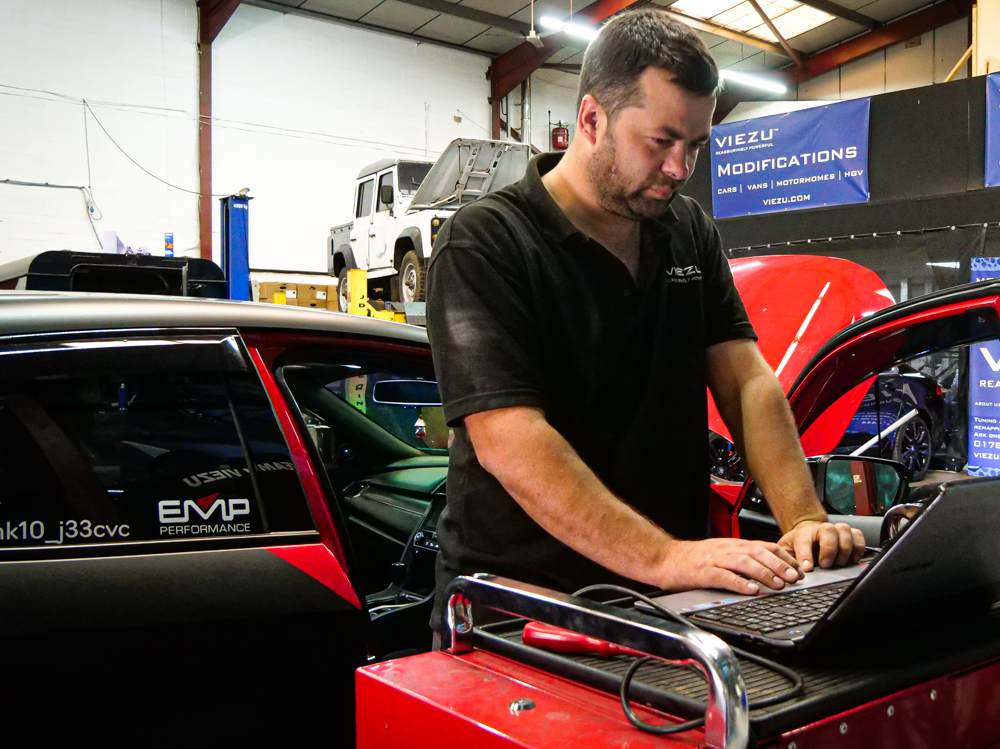
If you are starting out in tuning, or if you are looking for the specific tuning tools you need to tune a car, this guide cuts through the noise to tell you exactly what is required. We will walk you through the essential hardware, and compare the industry leaders in tools (KESS3 by Alientech, FLEX by Magic Motorsport and Autotuner by Autotuner). We will explain the software and the training you need to turn that equipment into a profitable business. If you are a complete beginner in vehicle tuning (or a workshop looking to upgrade), this is your roadmap to the right kit.
Understanding Car Tuning and ECU Remapping
Before we look at equipment, it is worth quickly touching on what car tuning actually is. Modern cars have an Engine Control Unit, or ECU. This is ‘the brain’ of the vehicle. It controls everything from fuel injection and ignition timing to turbocharger boost pressure. Factory settings are usually designed to meet the needs of the majority of customers or drivers – designed to meet a wide range of driving conditions and also global emissions regulations.
ECU remapping is the process of modifying this vehicle software. By carefully adjusting the parameters, a tuner can unlock more performance, improve fuel efficiency or tailor the engine’s characteristics to one driver’s particular needs. This is done by reading the original software from the ECU, modifying it and then writing it back. This read and write process is where the specific tuning tools you need to tune a car come into play.
Tuning Tool Hardware: The 3 Industry Leaders
To start remapping, you need a way to communicate with the ECU. When tuning professionals discuss the essential tools you need to tune a car, three manufacturers are usually mentioned as ‘industry leaders’ – Alientech with the KESS3, Magic Motorsport with the FLEX and Autotuner with Autotuner.
Many professional tuners eventually own all three of these tuning tools. Why? Because while these tools cover a lot of the same ground, they each have exclusive protocols or specific strengths. Having all three maximises the range of vehicles you can work on, providing equipment for entry-level engine tuning right through to advanced calibration.
Difference between master and slave tuning tools
When you buy a tuning tool, you will see the terms Master and Slave (or sometimes Slave is called a Client). Understanding the difference between master and slave tuning tools is vital before you invest in a tool.
- A Master tool gives you complete control. It reads the original file from the ECU, and you can open and edit this file yourself using separate software. It offers the most freedom – but it also requires the most knowledge.
- A Slave tool is linked to a Master tool, which is typically owned by another tuning company (like a tuning file provider, such as VIEZU). The Slave tool reads the file from the vehicle, but the file is encrypted. You send this file to your Master provider, who modifies it and sends it back for you to write to the vehicle. It is a safer, more guided entry into the tuning world, and you can tap into the experience and expertise of your Master provider. A good Master provider (such as VIEZU) will also give you full technical back-up and support.
View our guide KESS3 Slave vs KESS3 Master
1. Magic Motorsport FLEX
The Magic Motorsport FLEX tuning tool is an excellent tool and has one of the most extensive vehicle support lists.
- Warranty: One of its significant advantages is the lifetime warranty (provided that the subscription is active). This offers peace of mind.
- Usability: It is known for being very stable, and its datalogging capability is a welcome feature. Many users find its accessory kit, specifically the pin connectors, to be of a higher quality than others. Our own trainers often reach for the FLEX pins even when using other tools simply because they connect better.
- Strengths: It is strong for cloning ECUs and Transmission Control Units (TCUs). Magic Motorsport is often one of the first to unlock new tuning protocols for specific vehicles and offers excellent technical support.
2. Alientech KESS3
Alientech has been a big name in the tuning industry for a long time. The Alientech KESS3 is their latest tool, replacing the popular KessV2 and K-Tag. It combines OBD, Bench and Boot tuning into a single piece of hardware.
- Speed: The unit is known for being incredibly fast, with a microprocessor that is seven times more powerful than the previous generation.
- Connectivity: It features GPS, Bluetooth and Wi-Fi embedded in the platform. A clever feature is its ability to automatically recognise the correct communication line, which can speed up the connection process.
- Flexibility: You purchase the hardware first and then add protocols for the vehicles you want to work on, such as cars, bikes, trucks or marine applications. It comes with a 2-year warranty.
3. Autotuner
Autotuner has built a reputation for being a very fast and reliable tool.
- No Subscriptions: A key selling point is that it has no annual subscription costs. Once you buy it, it is yours to use without ongoing fees, which is a big financial consideration for many.
- Warranty: It comes with a 5-year warranty, which sits between the offerings from FLEX and Alientech.
- Strengths: It has strong support for later European vehicles and offers specific solutions for tuning ECUs that are sometimes locked by the manufacturer. For example, it has solutions for certain Mercedes and BMW models from 2020 onwards.
Supporting Hardware
Looking beyond the main tool and platform, a few other pieces of hardware are crucial. These are the supporting tuning tool accessories that you need to tune a car safely and effectively.
- A Battery Stabiliser: When you are reading or writing to an ECU, the vehicle’s ignition is on, but the engine is off. This drains the battery rapidly. A drop in voltage during a file write can corrupt the ECU, potentially causing major problems. A good quality battery stabiliser maintains a constant voltage and is an absolute necessity.
- Diagnostic Tool: Before you even think about tuning a vehicle, you must check for existing faults. A reliable OBD2 diagnostic tool allows you to read and clear diagnostic trouble codes (DTCs). Tuning a car with underlying mechanical issues is generally asking for trouble.
- Manual Tools: While we focus on software, do not forget the essential hand tools for performance engine tuning, such as socket sets and trim removal tools, which are required to physically remove an ECU from the vehicle if bench tuning is required.
The Dynamometer
While not essential for getting started with basic remapping, a dynamometer or dyno is the gold standard for professional custom tuning. It allows you to measure the engine’s power and torque in a controlled environment.
At the VIEZU Technologies HQ in Warwickshire, UK, we use a 3000hp Mustang MD-AWD-500 dynamometer. It is one of only a few in the UK capable of handling high-power 4WDs and heavy trucks. Because it uses a mechanically linked AWD system, it simulates ideal road-load conditions and ensures traction control systems do not interfere during testing.
Learn more about our expert dyno tuning courses
Tuning Software: Editing and Logging
Tuning Hardware is only half the story. If you step up to a Master tool, you will need tuning software to modify the files you read from the ECU.
WinOLS 5 and StageX
For professional tuners, WinOLS 5 is the industry standard for editing ECU files. It presents raw data in a way that allows a tuner to identify and modify maps precisely. However, it is complex and has a steep learning curve.
This is where StageX comes in. Many tuners are now using these two platforms together. StageX is excellent at recognising maps and can provide skins or driver packs that help you interpret the raw data in WinOLS. It acts as a validator, helping you find the right maps quickly so you can perform your calibration work in WinOLS with more confidence.
How to Choose Your Tuning Training Path
There is not a one size fits all approach to learning, training, and upskilling. Depending on your background, your path might look different.
1. The Absolute Beginner
If you are a mechanic or garage owner looking to add tuning as a new revenue stream, but have zero experience with files, you do not need to jump into complex software immediately.
- Start here: Our ECU remapping training courses for beginners are the best place to start. Look at our free tuning training courses to get the foundational vocabulary and concepts, and basic techniques.
- Next step: A Slave tool setup is the best option for getting started as it enables you to read and write to the ECU, you can then send the tuning file from your customer’s vehicle to your master tuner who takes care of the tuning file optimisations and edits. VIEZU provides expert support, returning tuning files quickly, between 20 minutes and 1 hour. Working with a slave tool means that you do not have to buy expensive tuning software licences immediately as you can upgrade later to a master tuning tool as your vehicle tuning skills develop.
2. The Intermediate Tuner
Perhaps you are already using one tool (like a KessV2) and want to modernise, or you want to move from just writing files to understanding how to change them.
- The path: This is the time to explore online car tuning training or attend a workshop to learn basic map writing. Expanding your tool collection (adding other tuning tools, i.e. buy an Autotuner or KESS3 if you already own a FLEX) will also open up more vehicle coverage.
3. The Professional / Advanced
You are already using WinOLS but want to specialise in complex jobs, like diesel DTC solutions or heavy-duty truck tuning.
- The path: Our in-person tuning training courses are ideal here. You can get hands-on experience in a workshop environment with the Mustang dyno, validating your custom files in real-time. We also offer specialised courses on using WinOLS and StageX together for smart and efficient workflows.
Why Choose Remap101 for Tuning Training and Upskilling?
Remap101 is the online home of the VIEZU Technical Academy (VTA). When you train with us, you are not just buying a course; you are benefiting from the broader experience of the VIEZU Technologies family.
We are an IMI Approved Training Centre – the Institute of the Motor Industry is the UK’s leading body for motor industry skills, and has a worldwide membership.
But perhaps the biggest advantage of the VIEZU Technical Academy is the ongoing support. Long after you complete your course, our technical backup, expert file writers and advice team are there to support your business growth. We do not just teach you and leave you to it.
Ready to Start Your Business?
Learning how to start a car remapping business can be daunting and buying everything separately can be a headache. VIEZU has specially curated tuning business start-up kits that bundle the tuning tools and accessories you need to start tuning cars and vehicles.
- Alientech KESS3 Business Start Up Kit
- Autotuner Tuning Business Start Up Kit
- Magic Motorsport FLEX Tuning Business Start Up Kit
We understand that the initial investment can be steep. That is why financial support is available via VIEZU’s FCA Compliant Finance Package, which may help you to buy these kits without large upfront costs. This means you can earn money from tuning while making monthly payments for the tools and equipment.
Tuning Tools You Need To Tune A Car Frequently Asked Questions
What tools do I need to tune my car?
To begin, you will need a reliable communication tool (like a KESS3, FLEX or Autotuner) to read and write the ECU data. Alongside this, a high-quality battery stabiliser is essential to maintain steady voltage, and a diagnostic scanner is required to check for faults before you begin. If you choose a Master tool, you will also need file editing software like WinOLS. Check out our tuning business start up kits which give you all of the foundations to get started including your tuning tool of choice, battery stabilisers, access to tuning training courses and more.
What do you need to do before you tune a car?
Before you even connect your tuning tool, you need to ensure the vehicle is healthy. This means running a full diagnostic scan to check for underlying fault codes (DTCs). You must also ensure you have a battery support unit (stabiliser) connected to keep the voltage steady during the process. Tuning a car with existing mechanical issues or low battery voltage is risky.
What are common tuning mistakes?
The most common mistake is failing to use a battery stabiliser; if the voltage drops during a write, you can brick the ECU. Another major error is tuning a car that has mechanical faults, hoping the remap will fix them – in fact, remapping like this can make the faults worse. Finally, using cheap, unverified files from the internet rather than from a reputable file provider can be a cause of engine damage.
Can I tune a car myself?
Yes, it is possible to tune a car yourself, but it comes with risks. Using Slave tools makes it safer as the technical calibration is handled by a professional master tuner. However, if you want to edit the files yourself, the learning curve is steep. We highly recommend professional training to avoid costly mistakes, as replacing a damaged ECU can cost thousands of pounds.
What is the difference between a master and a slave tool?
A master tool allows you to read, open and edit the ECU file yourself, giving you total independence. A slave tool reads the file, but it is encrypted and must be sent to a specific master provider for modification. Slave tools are a popular entry point as they provide a safety net and require less technical knowledge of map writing.
Do I need a dynamometer to tune a car?
No, you do not need a dynamometer to start. You can perform road tuning using datalogging to analyse the vehicle’s performance. However, a dyno is a much safer and more precise way to measure results and is considered essential for high-level professional custom tuning.
About The Author

Paul Busby is the CEO of Remap101 and is responsible for overall business growth and operations. As an experienced vehicle engineer, Paul has specialised in post-production defect investigation, new vehicle derivative homologation and warranty development at a manufacturer level. He was the winner of Entrepreneur of the Year in 2012 and led VIEZU to a Queen’s Award in 2014. When he is not working, he can usually be found getting his car fixed in the VIEZU workshop or showing off the F-Type Predator 670 BHP to customers.


