By Simon White, Master Trainer in Tuning and Course Development
Summary
If you are weighing up bench, OBD or boot tuning and wondering where to begin, we recommend starting with OBD tuning because it is the safest and quickest of the three methods. It doesn’t need disassembly of the vehicle or the ECU and it teaches you the connection and communication habits everything else builds on.
When you feel confident with OBD tuning, the next method is to move onto bench mode. Bench mode involves removing the ECU and connecting to it directly on a workbench.
Then Boot mode comes last because it is the most invasive and carries the highest risk of damaging the ECU. Learn them in that order and you protect your customers’ vehicles, your tools and your reputation while your skills catch up.
What OBD, Bench and Boot Tuning Actually Mean
Every modern petrol or diesel vehicle is controlled by an Engine Control Unit, the ECU. Tuning it means reading the existing software out of the unit, adjusting the maps and writing the new tuning file back in. The three methods are simply different ways of getting the file in and out. The mode you can use depends on the ECU, the manufacturer security on it and the tuning tool that you’re using.
There is no single best method. A tuner who only knows one tuning method will eventually meet a car they can’t work on. That is the real reason to learn all three tuning methods.
OBD Tuning: Where Everyone Should Start
OBD stands for On-Board Diagnostics. Every car built since the late 1990s has a standard 16-pin diagnostic socket, usually tucked under the dashboard near the driver’s footwell. OBD tuning means plugging a tool into that socket and communicating with the ECU while it stays exactly where it is, bolted into the car.
This is the method to learn first, and not just because it is convenient. Nothing comes apart. You are not removing the ECU, opening a casing or soldering anything. The manufacturers designed the OBD port for diagnostics and servicing, so the connection is stable and forgiving. That makes it the ideal place to build the habits that carry into the harder methods: identifying the ECU correctly, hooking up a good battery stabiliser so the voltage never dips mid-write, making a clean connection, reading a file, checking it and writing it back.
The battery stabiliser is important in this process. A large share of beginner OBD write failures happen because the car’s battery drops below 12 volts partway through, and a stabiliser removes that risk entirely.
Newer ECUs often have security gateways or anti-tuning locks that block reading or writing over OBD. When that happens you need bench or boot mode. So OBD teaches you the fundamentals on the widest possible range of vehicles, then when you’re confident, learn the next method.
Our Autotuner OBD mode course walks through exactly how to set up the Autotuner tool and how to make the right connections to an ECU through the port. If you tune with Magic Motorsport FLEX hardware, the Magic Motorsport Flex OBD course covers the same ground for that tool.
Bench Tuning: The Logical Second Step
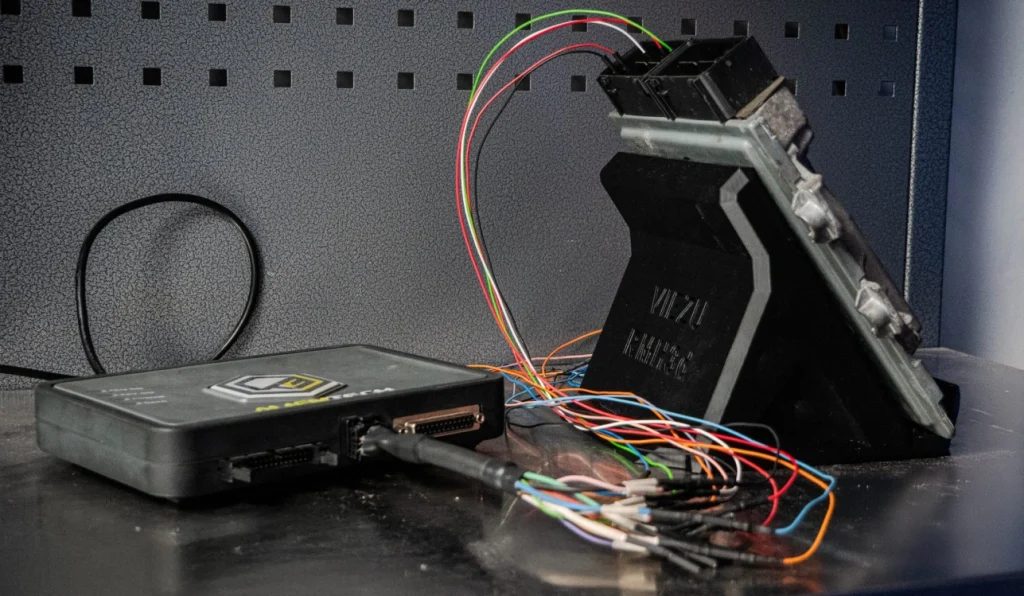
Bench tuning, sometimes called service mode, is the tuning mode to use when the OBD is blocked. You remove the ECU from the vehicle, take it to a workbench and connect your tool directly to the unit’s main connector pins using a dedicated cable or boot adaptor. The ECU casing stays shut. You are bypassing the car’s electrical network and the manufacturer’s OBD restrictions, but you are not opening the unit itself.
The first step is that you have to locate the ECU in the car, remove it without damaging connectors or wiring, identify the correct pinout and power the unit safely on the bench. None of that is dangerous to the ECU if you are methodical and know what you’re doing. Working off the car removes some of the electrical risks that can occur with the ignition live, so in some respects the bench is a more controlled environment once the unit is out.
Learning bench mode unlocks the range of cars that you can work on. Our Autotuner bench mode course covers the connections and the software workflow, and there is a matching Magic Motorsport Flex bench course for bench mode with the FLEX tuning tool.
 Boot Tuning: Save It For Last
Boot mode is the most advanced of the three different tuning methods and is the most risky because it involves you removing the ECU, opening its casing and connecting needles or soldering wires directly onto the microprocessor’s boot pins or circuit board. One small error can cost you hundreds of pounds to fix.
Because of the risks that come with boot tuning, a lot of professional tuners recommend learning this last. Boot mode is generally reserved for cloning an ECU or getting past heavy manufacturer security, such as the protections found on some Bosch units, that nothing else will open. It is a specialist tool, not a daily one, and it rewards a steady hand built up over months of OBD and bench work rather than a beginner on day one of their tuning journey. By the time you need boot mode, the careful connection habits you formed earlier are important. Our Autotuner boot mode course and the Magic Motorsport Flex boot course cover the method in full.
The Order That Keeps You Out Of Trouble
We advise learning OBD, then bench, then boot. Each step adds a little more skills and risk, but if you learn in this order, each method builds your experience ready to learn the next mode.
Something that we recommend is practicising on cheap second-hand ECUs from a scrap yard or an auction so that you are not working on customers’ vehicles. This can save you money and build your confidence. Make any mistakes early, somewhere they do not matter.
It also helps to understand that the tool and the software are two different skills. Knowing how to read and write a file in OBD, bench or boot mode gets the data in and out. Knowing what to change inside that file is a separate discipline, which is where file writing and map editing come in. Our how to read and write an ECU with KESS3 course focuses on the reading and writing side, and you can layer the editing skills on top once your connections are second nature.
Which Tuning Tools Cover Which Modes
With the advancement of tuning tools, you can now handle bench, boot and OBD tuning with all of the leading tuning tools, Alientech brought out the KESS3 to replace the KTAG and KESS3, the Alientech KESS3 handles OBD, bench and boot in a single unit. The Autotuner tool covers all three modes too across thousands of vehicles, with no ongoing subscription and Magic Motorsport Flex is widely used across OBD, bench and boot as well, with its boot work often done using a dedicated positioning frame and probes.
If you are unsure which tuning tool hardware suits the work you want to do, we are always happy to help, you can speak to us via our website live chat during working hours or send us a message via the form on our contact page.
We also have a range of useful guides to help you get started:
- Choosing your vehicle tuning training path
- Browse the full range of hardware tuning tool training to see more information on each tool
Can You Teach Yourself, Or Do You Need Training
You can buy a tuning tool, watch a few videos and start experimenting, plenty of people do. The problem is that the cheapest mistakes in this trade are the ones you make in a controlled setting with someone explaining why, not the ones you make on a customer’s car with their keys in your hand.
Structured vehicle tuning training such as our beginner tuning training helps you to learn the tuning methods in the right sequence. You can train online at your own pace or come to us in person, where you can work in a safe environment, depending on what you are learning, some of our tuning courses include hands-on sessions on our in-house dyno which is where you can see the results in real time. There is more on the difference between the two formats in our piece on learning car tuning online versus hands-on.
About The Author
This article was written by Simon White, Master Trainer in Tuning and Course Development at the VIEZU Technical Academy (VTA), the academy behind Remap101. Simon has 20 years of experience as a tuner and vehicle software programmer across all types of vehicles, and he is an EVC-certified trainer. He is also Technical Director and Managing Director of VIEZU.
Simon leads the VIEZU Technical Academy and has developed and delivered in-person tuning tools and software training worldwide. He also developed the VIEZU Technical Academy online tuning training offer, which runs to more than 50 modules covering the major tuning and calibration tools and software platforms.
Why Choose Remap101 For Your Tuning Training
Remap 101 is the online home of the VIEZU Technical Academy (VTA), an integral part of the VIEZU Technologies family. Training with us means you are not just buying a car tuning course, you get the wider experience of the group: the technical back-up, the expert tuning file writers and the industry-leading file service. You get access to support after your course ends, so if you do find yourself working on a customer’s vehicle where things aren’t going to plan, we can help you.
The VTA is an IMI-Approved Training Centre. We teach across every method covered here, on the tools most professional tuners actually use, and we cater for two very different starting points. Whether you’re looking for beginner tuning training courses to advanced, we work with a range of people from individuals looking to start a new hobby or career, right through to garage owners and who want to add ECU tuning as a profitable service alongside what they already do. You can train online from anywhere or in person at our headquarters, and you can see what is running next on our course calendar.
Have some questions about learning to tune? Contact the team or call +44 (0) 1789 774444 and we will point you to the right starting course.
FAQs On Bench OBD And Boot Tuning
What is the difference between boot and bench tuning?
Both involve removing the ECU from the vehicle, but they differ in how deep you go. Bench tuning connects to the ECU’s main connector pins with the casing still closed, bypassing the OBD port while leaving the unit sealed. Boot tuning goes a step further: you open the casing and connect needles or solder directly onto the boot pins on the circuit board. Boot is more invasive, riskier and reserved for ECUs that bench mode cannot read, such as units with heavy manufacturer security.
Can I reprogram my ECU myself?
Technically yes, with the right tuning tool and tuning software you can read, edit and write your own ECU. Whether you should is a different question. Without training it is easy to misidentify the ECU, lose communication mid-write or load an unsuitable file, any of which can leave the vehicle undriveable. If you intend to do it properly, and certainly if you plan to tune other people’s cars, structured training is the difference between a clean job and an expensive lesson.
What is the downside of ECU tuning?
Done badly, tuning can affect reliability, emissions compliance and your insurance position, and an interrupted write can damage the ECU. Done well, by someone who understands the maps and the limits of the engine, it is a controlled, reversible change. The downsides almost always trace back to inexperience or a careless write, which is exactly what learning the methods in the right order is designed to prevent.
What is stage 1, 2 and 3 tuning?
These describe how far a tune goes, not how the file is read. Stage 1 is a software-only remap that works within the standard hardware, suitable for most road cars. Stage 2 assumes supporting hardware upgrades such as a freer-flowing exhaust or improved intake. Stage 3 involves more serious mechanical changes like a larger turbo and is aimed at heavily modified vehicles. The OBD, bench or boot decision is about getting the file in and out. The stage is about what you do to it.
Do I need to learn all three methods?
Eventually, yes, if you want to tune professionally. A tuner who only knows OBD will be limited in what vehicles they can work on which if you’re running a tuning business can mean that you’re tuning away work. Learning bench tuning and then boot tuning means that you have more experience to work on a wider range of vehicles.
Which tuning tool should I buy first?
Almost any modern tool worth buying, the Alientech KESS3, Autotuner and Magic Motorsport Flex among them, does OBD, bench and boot in one unit, so the decision is rarely about which modes it covers. It comes down to other factors. The subscription model is a big one: Autotuner has no annual licence fee, which keeps overheads down, while KESS3 carries a subscription.
Vehicle focus matters too, as Autotuner is particularly strong on newer German cars like BMW and Mercedes, whereas KESS3 is known for broad all-round coverage across a wide variety of vehicles. And the kind of work you want to do can be decisive, with Flex widely regarded as the leader for gearbox and transmission control unit tuning. So the honest answer is that it depends on the vehicles you plan to work on, the brands you see most and how you want to handle running costs. Browse the hardware tuning tool training range to see the options, and talk to the team before you spend anything so the tuning tool matches your goals.


